

Table of Contents
- What Is a Spring Turn Service?
- Spring 2025: What We Learned from Last Season
- Why Timing Matters in Spring 2026
- Spring Turn Services Checklist for 2026
- Benefits of Professional Spring Turn Services
- Planning Your Spring Turn Service for 2026
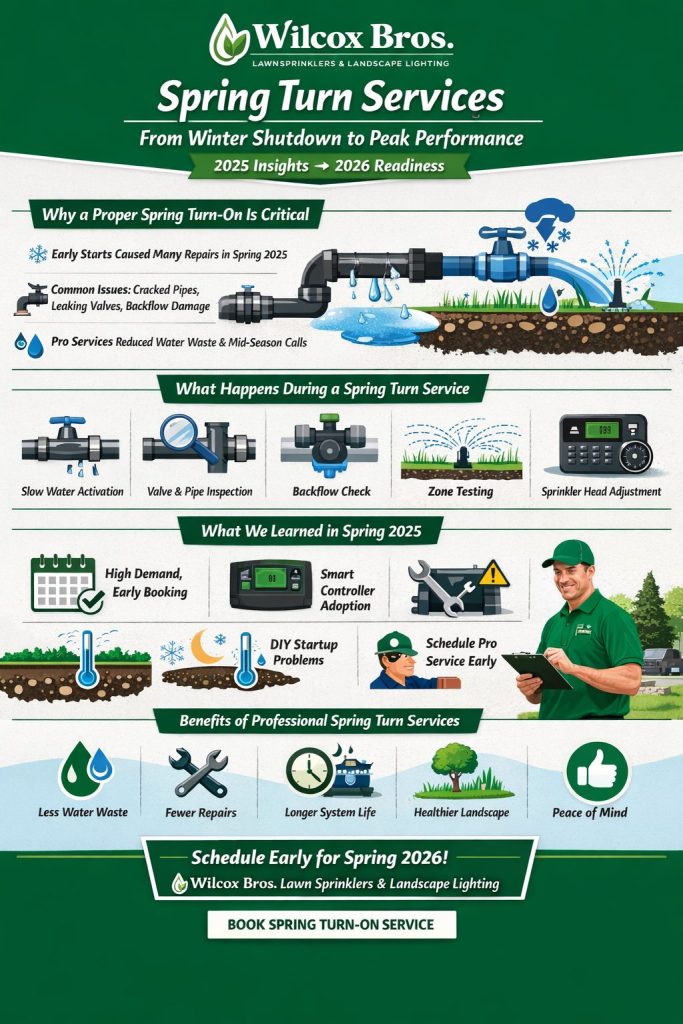
What Is a Spring Turn Service?
A Spring Turn Service—also known as a spring turn-on or irrigation startup—is the professional process of safely bringing an irrigation system out of winter dormancy. The goal is to restore water flow gradually, identify winter-related damage, and ensure the system operates efficiently for the upcoming growing season.
A standard spring turn service typically includes:
- Slowly turning on the main water supply to prevent pressure shock
- Inspecting valves, pipes, fittings, and sprinkler heads for winter damage
- Testing each irrigation zone for leaks and proper operation
- Adjusting sprinkler heads for accurate and efficient coverage
- Programming the irrigation controller for spring watering schedules
This structured approach reduces the risk of mid-season failures and helps extend the lifespan of the irrigation system.
Spring 2025: What We Learned from Last Season
The Spring 2025 irrigation season highlighted several trends that directly influence how systems should be prepared for Spring 2026.
High Demand for Early Scheduling
In 2025, irrigation service providers experienced a sharp increase in early-season demand. Many homeowners and commercial properties scheduled spring turn services as soon as frost risks subsided, causing service calendars to fill quickly.
Growing Emphasis on Water Efficiency
Spring 2025 saw increased adoption of smart irrigation controllers and weather-based scheduling. Rising water costs and sustainability initiatives pushed property owners to prioritize efficiency and precise watering.
Increased Repairs from Improper DIY Startups
A significant number of service calls in 2025 were linked to systems being activated too quickly or too early. Common issues included cracked pipes, leaking valves, and damaged backflow assemblies—many of which could have been avoided with professional spring turn services.
Why Timing Matters in Spring 2026
Timing remains one of the most critical factors in a successful spring turn. Turning on an irrigation system while underground soil temperatures remain below freezing can lead to serious damage.
For Spring 2026, fluctuating weather patterns and earlier thaws in some regions make professional evaluation especially important. A trained technician can assess soil conditions, system pressure, and component readiness before water is restored.
As a general rule, irrigation systems should only be activated once overnight temperatures consistently remain above freezing.
Spring Turn Services Checklist for 2026
A comprehensive Spring 2026 irrigation startup should include:
- Winterization Review
Confirmation that the system was properly drained and winterized in the fall. - Main Line and Valve Inspection
Identification of leaks, cracked fittings, or pressure irregularities. - Backflow Prevention Inspection
Verification that the backflow device is intact, operational, and code-compliant. - Controlled System Pressurization
Gradual restoration of water pressure to prevent water hammer and pipe failure. - Zone-by-Zone Testing
Manual testing of each irrigation zone to confirm proper coverage and alignment. - Controller Programming
Updating seasonal schedules and calibrating smart controllers for spring conditions.
Benefits of Professional Spring Turn Services
Professional spring turn services provide clear advantages over DIY startups, including:
- Early detection of winter-related damage
- Reduced water waste through optimized irrigation coverage
- Lower risk of mid-season breakdowns and emergency repairs
- Extended lifespan of irrigation components
- Compliance with local backflow and water regulations
These benefits are especially valuable for larger residential properties, HOAs, and commercial landscapes with complex irrigation systems.
Planning Your Spring Turn Service for 2026
Based on the demand patterns observed during Spring 2025, scheduling early for Spring 2026 turn-on services is strongly recommended. Early booking ensures priority placement once weather conditions allow and minimizes delays during peak season.
Spring turn services are a preventive investment in irrigation performance, water efficiency, and long-term system reliability. With proper planning and professional execution, Spring 2026 can begin with confidence and uninterrupted landscape care.